[ArtBlog#1] Learning Art Without Guidance – Part 1
I’ve started learning art with conscious effort in 2024 with hardly a concept of how to go about it. In a way, I still think that’s the best introduction to something you’ve never done before. It lets you go into this new experience without expectations, preserving that sense of innocence and wonder that likely drew you to it in the first place.
Obviously that shouldn’t be the modus operandi forever, but especially if you overthink a lot or experience work blocks and maybe stress from how this work is going to be perceived, finding a way to cast off these doubts is essential.
Nothing will be as effective as a structured approach to improvement and at some point it’s either eat or die (rather ‚practice or stagnate‘, but eh). And chances are, like with me, there are nasty habits left over from this innocent beginning that can truly hurt further progress.
While I’m still nothing that you could call a professional and doubtful if I could effectively ‚teach‘ art, there’s still two or three wisdoms that I can share. Some of which I even tackled early on!
For this, I want to share the full set of my very first drawings I ever made after embarking on my art journey and talk a bit about these early steps, now roughly 2 and a half years later. Like I said in the introduction, it was an unplanned and quite spontaneous event.
On the first of February 2024 I’ve simply decided to draw one page for 30 days as a challenge.

Now, I’m sorry for that hideous flashbang right on day 01. These first days without much experience are quite valuable for one thing, which is showing the level of craft with brutal honesty. Aside from random symbols or Japanese signs (which I did repeatedly to practice new kanji while I was already doodling) I already tried to get a grip on faces and construction. With no understanding of how a Loomis method or any variation of the „make cross, then draw face“-technique was supposed to work the first three days turned out appropriately amusing.
Here’s the first tip that I tested out day 03, which is to at least give yourself 5 seconds of thinking about proportions. That is the dragon head and cat doodles which were from a random quick tutorial I looked up. Even though one could criticise these (especially whatever bone issue that cat has), they did one thing right. They showed a shift of thought towards the proportionality of things in abstract form. Like how that dragon head is actually just three circles following two diverging lines or the cat also being three slightly overlapping circles of decreasing size.
This mental trick of simplifying shapes, movement and proportions goes a long way to help with constructing a drawing.
Which I promptly explored further by incorporating actual references on day 04, Jean from Attack on Titan and smurf grandpa. Under these the circles can still be seen, which I used to simplify the shape I saw and around which I practiced to place the image I saw in the reference again. It went so well that I even filled in simple shading for a more complete look.
Even a day later, without a proper reference, there was noticeable improvement on the construction of bodies simply by shifting the mental focus on proportions first. It’s still wonky and full of chicken scratching, but being actively observant and narrowing down on what exactly it is that I disliked about what I drew is immensely helpful in finding out how to improve.
Case in point, from here on I already noticed how the chicken scratching - or fast and quick line drawing with a whole lot of short, overlapping strokes to get the desired shape more accurately – was an issue. In the beginning it really seems like it helps, since nearly everyone can draw short lines the way they want rather well, but long lines are extremely difficult to get accurate when you don’t have the motorics skills yet to pull it off.
Here’s also where watching some creators on YouTube, like SamDoesArts or Prikat that I watch, that also provide helpful critique can save a lot of time for finding the next step. That, and chicken scratches just look terrible.
If you can help it, try to stop bad practices before they become routine. From here on out I’ve also tried to be more aware of intentionally making clear lines that try to be the full shape of what they’re supposed to outline.
The next few days were mostly spent doing two things: Intentional line and shape drawing and testing out Krita’s brushes and some colouring. It’s a slight wonder to me that despite the noticeable improvability of day 07‘s postcard drawing especially on the perspective side of things the general setting of moody, rainy day is somehow there.
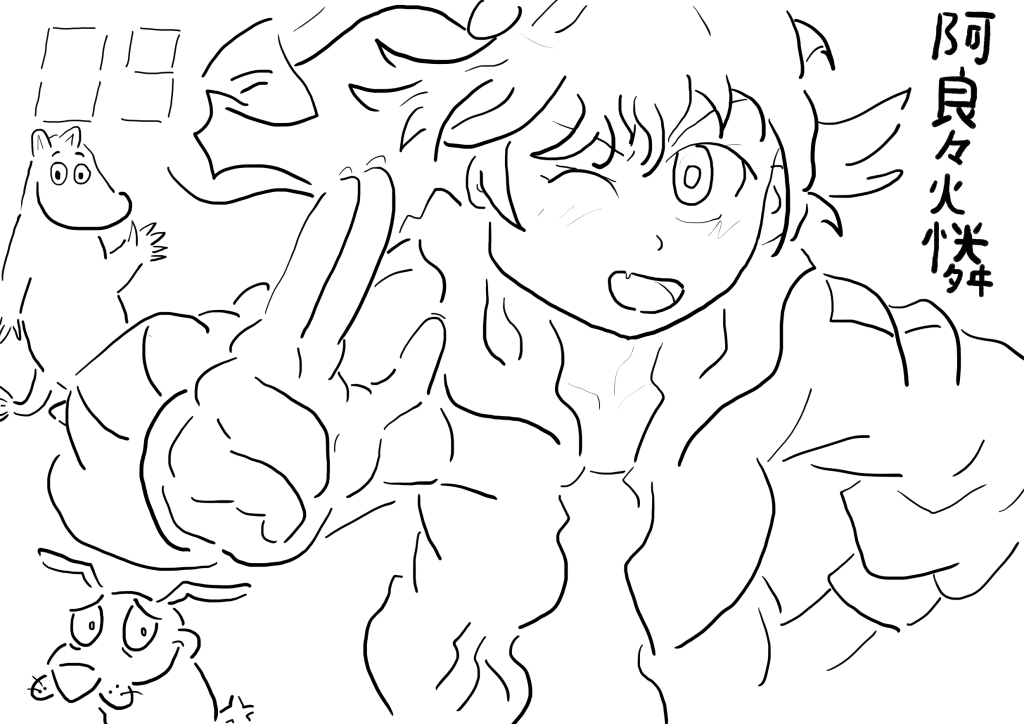
Day 08 and 09 mark the first dedicated practice of hand drawn, full-length lines. In case of FALKE (Please play SIGNALIS) I constructed a grid that should contain the letters, outlined the size and font characteristics, and then drew the actual outline for filling with one stroke for each side. Mostly at least.
For Karen (Monogatari Series) on day 09 I gave myself the task of simplifying the reference into characteristic lines that would carry over the dynamics of the pose. Also, Moomin and Courage. I’d say doing this is quite helpful in finding out the identity of a design and why its shapes work.
My tip here would be to also do lots of figure and gesture drawing exercises, since that’s the entire point of the practice. Seeing action lines, shapes, forms and ‚energy‘ condensed into as few lines as possible. I didn’t do this at all in this 30 day challenge since I went in completely guideless, but trust me, working up the experience through large amounts of figure drawing exercises from references is a proven method for a reason. Now, I’d definitely force myself to at least do it every few days when time travelling back.
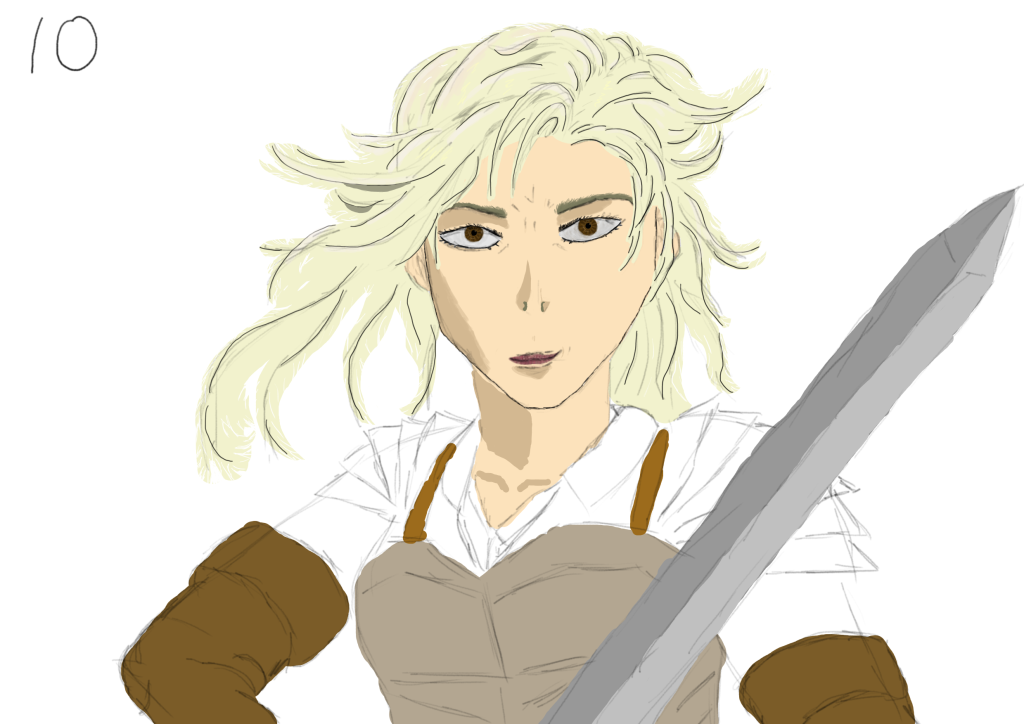
Most of the next week was random practices and doodling along with practicing kana. But day 10 is especially noteworthy not only because I tried to get a full-page portrait from a reference done in an hour, but there’s a cautionary tale in it, too.
The most obvious takeaway is that any experienced artist probably immediately chuckles upon seeing that compilation of beginner mistakes on full display. Outlining eyes and mouth, questionable proportions, and shading gone far too detailed too soon without establishing the scene are major ones. But the issues began even before putting digital ink on the canvas. I fell for the unfortunate trap many new aspiring artists nowadays have to deal with: The reference turned out to be AI and I didn’t notice until much later. (Thanks, Pinterest...)
It’s the reason why I dropped this picture right then and there, since learning from an intent-less amalgamation of stolen patterns that has been remixed from a text promp is hardly anything worth learning from. It’s also probably the reason why the following days were mostly thoughtless doodles along with testing out a few things like brushes and simple shading.
There’s one good thing coming out of this week, though. And that is that I discovered one of my favourite methods of digital drawing. That being drawing by erasure, or interlacing two colours, as can be seen in the hair on day 10. In short, to draw the greater shape in the positive colour first and then set the brush to erase and draw into its shape from the outside the negative or the second colour.
Still, just like my last tip try to find as many references as possible. Luckily there are enough art resources or courses online that take on the vetting process for you and filter out AI. Even better, they usually bundle these by lesson or exercise.
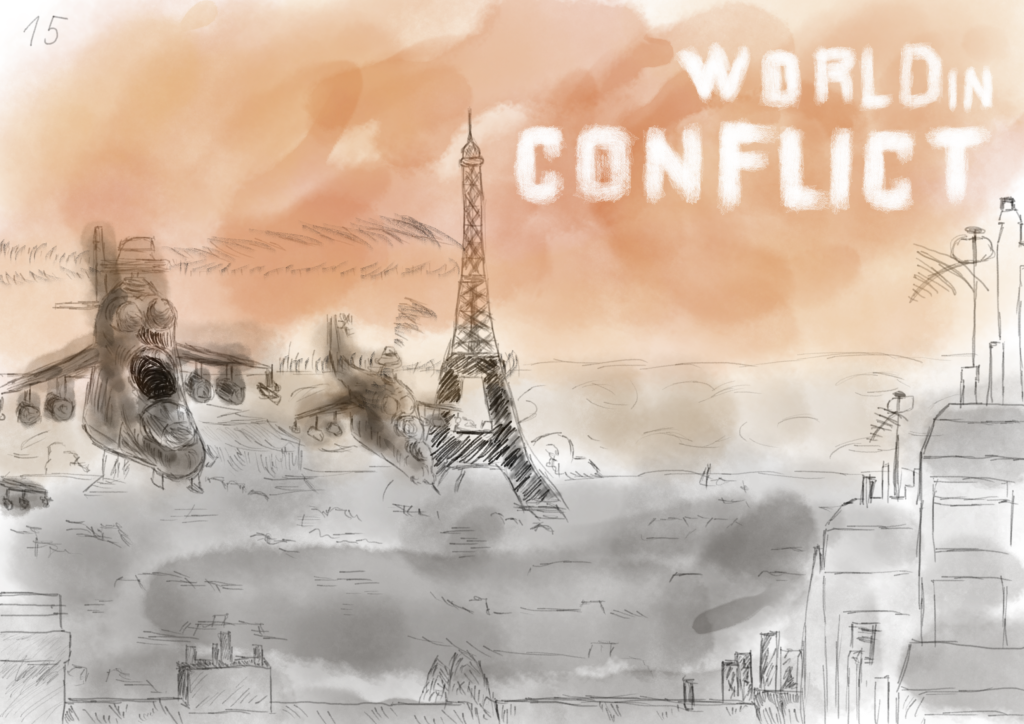
Now, on day 15 I had that sudden surge of nostalgia that hits you every once in a while. Though it seems like I have unlearned my lesson on chicken scratching, it’s one of those pictures that I still remember drawing because it was pure fun to do. I always loved World in Conflict for it’s great atmosphere and amazing story.
On day 16 I somewhat broke the spirit of the challenge by looking up exercises online and landed on texturing and shape warmups. Stuff like hatching a square as parallel as you can, creating a soft feeling with dots or little dashes, or a bent surface with relief lines. Also a little tip for everyone for fun: Try to add an explosion every once in a while and make it with a different shape identity each time. They’re not only fun to watch, but also interesting to draw!
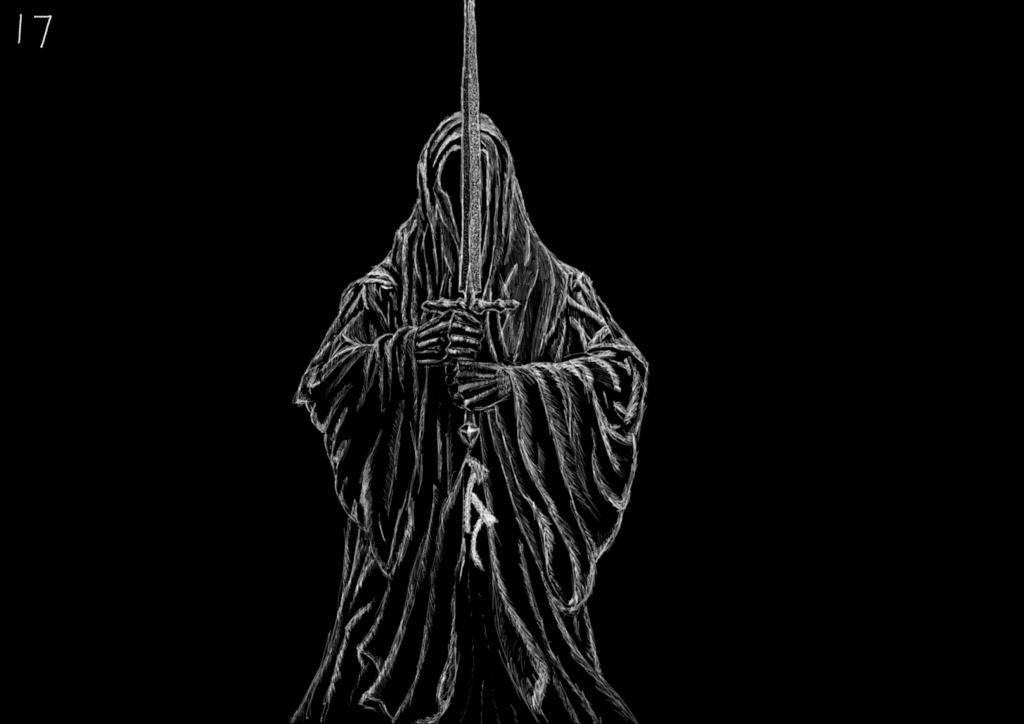
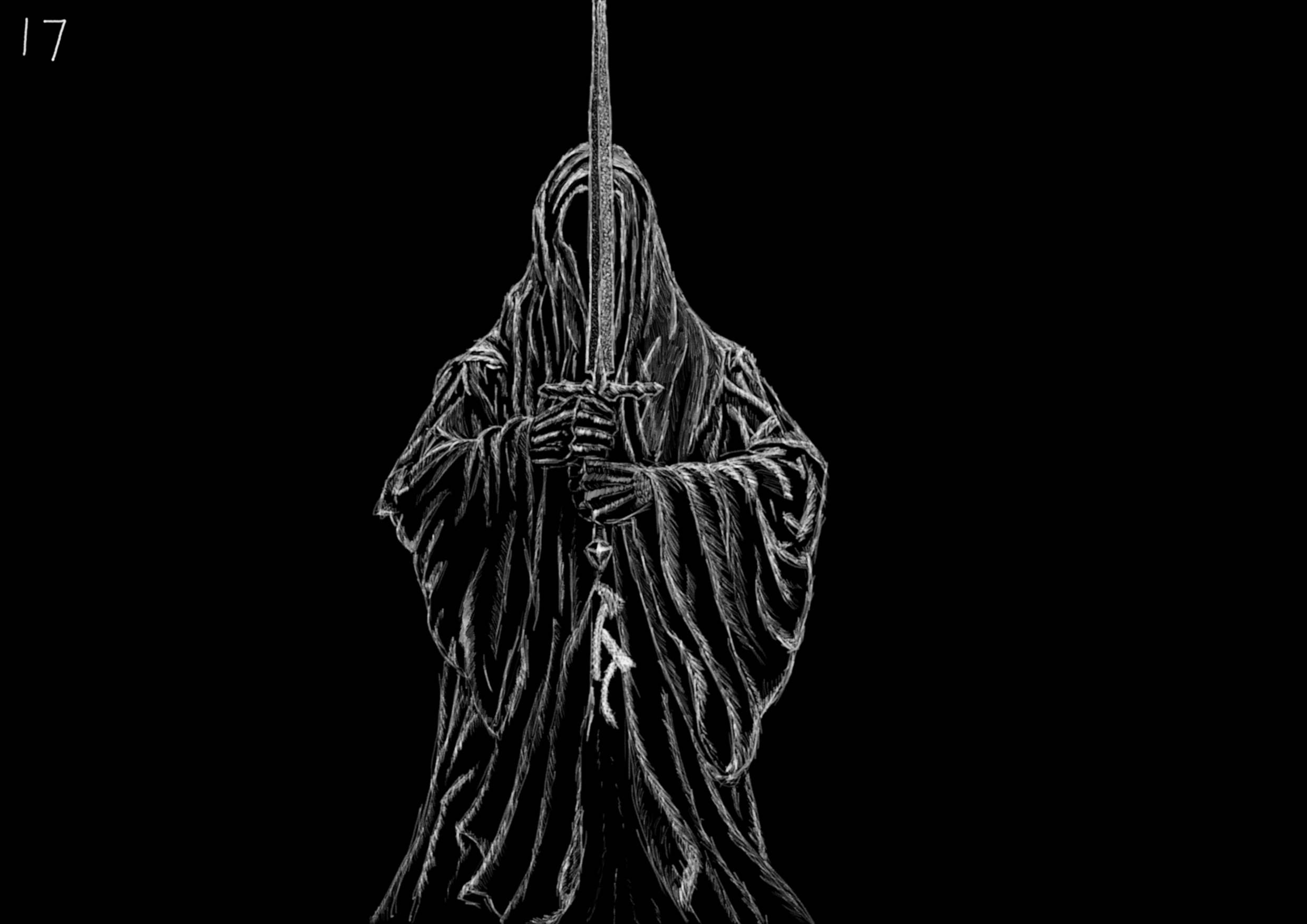
I want to close this first half with what would become my actual first proper art piece on day 17. It’s when I consciously tried to combine all that I thought I had already learned and apply it to drawing a ring wraith from Lord of the Rings.
I still love to look at this one because it’s such a cool milestone to have when looking back at how it started merely two weeks ago by that point. Similar to day 09‘s Karen I tried to make each line represent the form of the wraith’s coat fabric. Like all the shading and texture exercises, I tried to let hatching tell of both light and material. And, like the technique I discovered on day 10, I decided to draw the entire picture as a negative. It not only fit the mood so well, being about a dark ring wraith, after all, I also found the idea to only draw with what basically are exaggerated highlights very engaging.
While reviewing these first days from years ago I think that the mindset that helped me most in pressing on and getting better was actively paying attention. To be aware of what I was actually doing with the pen, what I imagined and how it translated to the screen. Many of the fundamental concepts of art come surprisingly quickly as a natural improvement in consequence of this, at least for me. Thinking of how I wanted something to look and feel made me evaluate what I know and how I could use it to achieve that look. Which then let me dedicate myself to every line.
It’s what I would give away as my final advice here: Cycle between the observant student and the proud master in your mind while creating. Observe what is in front of you and criticise the good and the bad, then formulate what you can improve. When applying this improvement, commit to every stroke and be the master that doesn’t let anyone distract or tell them what to do. Then repeat.
I think that’s a rather simple concept that provides a balance of learning and creating.