Devlog [Project Charlie #01] - Sketching an Idea
In some way, all projects start with a dream. Some wish of a thing that fulfills a very personal desire that is not available or reachable yet. But dreams are also often effusive and blurry, representing a state of feeling more than a concrete state. Before anything else it's sensible to catch that dream before it diffuses into something else and wring out legible statements that mark why it was alluring in the first place.
I do have a dream of a game that I wish I could play. It involves exploration of an uncharted land beyond the borders marking the edges of maps. It challenges me with encounters of life, cultures and civilisations of foreign and unknown nature. It is all free and dire and impactful with the choices it forces me to make. It also is deeply engaged with the meaning of choices, their consequences and that these leave marks. And lastly, it is also a game that allows me to think, to plan and to build around an interlinked system of production, needs, allegiance and progress.
The Gameplay Niche
Even with how muddy that sounds, writing this idea out already cleared up quite a few things. And I want to start this with narrowing down the gameplay.
The last point is probably the clearest to me. I have long since wished for more Strategy games and for more innovation in this genre, as well. Even if it might seem so it's not a dead genre, but it certainly feels stagnant. Well, even regressive one might think when looking at the gems of the olden days: Warzone 2100 and Command & Conquer: Generals, to name just two.
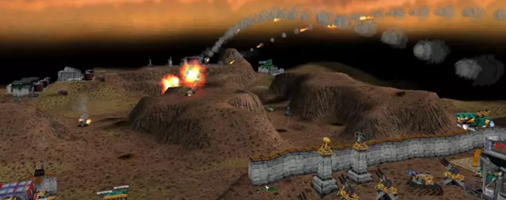
I cannot think of any strategy game of recent years that would have provided a novel concept even nearly as interesting as Warzone's different handling of direct line of sight, various sensor-based detectors like radar, and counter-based detectors like artillery fire sensors. It was possible to have your units shoot an enemy on sight like normally. To assign a unit to a sensor or detector tower, making it a weapons extension of the sensor's sight and greatly increasing its range in case of indirect fire weapons. Or to assign it to a counter-battery sensor that would detect from where enemy indirect fire came from, ordering a counter battery salvo on that position. That was in 1999.
And in 2003 the Command & Conquer series arguably had its last high with the reselase of Generals, one of my all-time favourite real time strategy games. As was somehow usual for the time, it had a surprisingly deep (not that deep, but more than one would expect, especially nowadays) political story and some of the best designed asymmetrical gameplay with its three major factions representing Western technological superiority, Eastern overwhelming force and mass, and an insurgent uprising playing around stealth, surprise and fast guerilla tactics.
Of course it's not fair to disregard everything else that happened in the remaining 23 years. There was They Are Billions in 2019, succfessfully fusing a strategy game with horde mode in the indie-mainstream and kicking off a genre that also spawned From Glory to Goo (2024) which I dearly love. Supreme Commander (2007) shall not go unnamed as well as the various grand strategy entries from Stellaris (2016) to Total Warhammer (2016) (Shut up, that's its real name!)

However, it doesn't truly feel like any of them truly expanded the genre in a direction it wasn't already sitting in or headed. There were various smaller entries that combined genres, like with an FPS where you run around personally on the battlefield and command your faction, but improvement largely felt like refinement, adaptation or fusion in a gimmicky sense. Which is not to say I dislike it, I loved the Dawn of Wars and the Civilisations and their contemporaries! But the only game in recent memory that truly shook up the genre's foundation that I can think of is Terra Invicta (2026).
It did something that I came to value to much and am now melancholically missing in every other streategy game, even if it might not be a benefit for a particular game's gameplay. For the first time it truly felt like all the things I as the player was controlling had an existence without me. And it made that control fragile.
Terra Invicta is a strategy game on the grandest of scale I have seen yet. Not the biggest scale technically, but the largest spread ranging from singular humans over meganation complexes spanning several continents to the entire industrial capacity of the solar system. It's also why people joke it's three games in a trenchcoat held together by spaghetti code. It's not exactly a false statement, to be honest. There's an aspect about political and social manipulation enacted by one of the seven ideologies the player plays as. It's the only thing that is not changeable after starting a playthrough. Here, you pick your shadow organisation that will recruit agents to steer the world, its nations and people however you think they should be and plot against the other six so they don't achieve their goals. There's the space gameplay that is resembling logistical and the classical build-up aspects most where you gather resources to expand into the solar system and build space ships to fight with. And lastly, there's the space battle layer where the actual combat takes place, which is basically a 3D tactical battle sim.
What the game did was severing your absolute ownership of units, buildings, factions, entire nations. Hell, even your information on screen could be a lie. Everything had to be worked for, earned, and continuously defended to stay yours. And they largely could exist without being controlled by anyone, too. Whenever I browse for new releases or another game to play, I do catch myself thinking, "Does it do the Terra Invicta thing?", and getting ever so slightly disappointed that, no, it doesn't.

So, I want my game to be Terra Invicta, then? Not really, but this idea that every element of 'my' stuff isn't just a number or abstract tool and instead an embedded resident entity of the game world with a history and a place is deeply enticing to me.
Defining the Gameplay Loop
My game is a strategy game about exploration, building a civilisation and treating the world as a living thing that changes and is never static.
That already means an interesting divergence from the classical strategy formula that encompasses a loop of explore -> gather resources -> build units -> fight opponents. Treating those under your control as something that can change means it must be maintained and that there is another state it can change to outside of your control. This loop has to be expanded to account for the aspect of maintain control.
And more than that, the world itself and its inhabitants cannot be static, either, else what would challenge this control one has to maintain?
Applying this to the standard strategy gameplay loop means three things:
- Resources need to be able to be lost or tied to an influence that requires recurring effort
- Units need to have requirements beyond the resource cost for generating them
- The additions need to apply to opponents, as well
For the game's mechanics that means two elements need to be incorporated into its design: 1) A production and consumption system that orders the maintenance and access to units and buildings and the like. And 2) a needs table that lays out sufficiency and stability requirements as well as benefits and repercussions for meeting or not meeting them.
This is something another genre already explored quite a bit: Colony Sims like Timberborn (2026), Rimworld (2018) (especially with the Ideology DLC (2021)) or City Builders like the Anno series feature various levels of in-depth simulation and production mechanics that are required to master them. But still, their goal eventually aligns with dominance and removing competition through superiority.
Rimworld's foundational idea is probably the closest of what scratches the itch I have. Pawns in the game have continuously depleting status bars like hunger and sleep that need to be cared for. There is a social system that simulates relationships, rivalries, belief and mental state. And all of these things are solved through gameplay in the world space where food is grown, recreation is lived and the elements rage.
Instead of simply taking the Rimworld formula and running off to make a prototype strategy game with it, I'd like to take this lesson somewhere else first. In the end, Rimworld's long-term allure largely comes from roleplay and/or challenges that the various settings and world-difficulties of its systems allow to play out. I am indeed looking for something that places the control itself more center on the stage rather than what the outcome of using it is.
Which is why I want to see where the following idea leads in a strategy game:
explore -> gather resources -> influence the world -> attain control
Having control is the desired outcome instead of a guaranteed assumption and most of the gameplay loop revolves around managing the process of sustaining it.
This opens up a whole new level of gameplay elements that I've rarely seen explored in the genre. For example, fighting does not need to be a part of this formula if control can be gained with trade or by religious influence. Implementing mechanics that leverage other factions to do something for the player feels much more natural to this loop, too, and could build on already existing systems (once they actually exist, of course). I could dream up more, but the really important bit is just this.
I think I'm really excited to explore this idea and try to giv ethis dream of mine a shape!